
Every so often the mainstream press catches up to something that's been building for years. In July 2026, the Wall Street Journal published a feature declaring that passive income has replaced the corner office as the American career dream. It's a sharp, honest piece — it celebrates the people quietly earning while they sleep, and it names the traps that swallow everyone else. One of its success stories will look very familiar to our clients: eBay stores selling marked-up Amazon products, run day-to-day by an operator, while the store's owner checks in about an hour a week. That is, almost word for word, what Dealixo does. Here's our take on the article — including the parts that should make you cautious.
What the Journal actually found
The article's core observation is that faith in the traditional career is cracking. It cites survey data showing more than half of Americans — and about 60% of Gen Z — no longer believe a conventional job will get them to their financial goals, and reports that worker satisfaction with pay and promotion opportunities has hit its lowest point since the Federal Reserve began tracking it.
The response has been a stampede toward income that doesn't bill by the hour: roughly a quarter of Americans now run some kind of side hustle, Google searches for “passive income” have grown about 50% since 2020, and Reddit's passive-income community draws around half a million visitors a week.
The people profiled range from an engineer whose oversized lint roller earns him up to $115,000 a year for two hours of work a month, to a voice actor collecting about $3,000 a month licensing an AI clone of his voice.
The profile that looks exactly like us
Buried in the middle of the piece is the example that made us sit up: an operator who runs eBay stores that resell Amazon products at a markup — not just for himself, but for clients who open eBay stores and hand him the keys. One of those clients, a young man now living in Latvia, told the Journal his cut comes to about $6,000 a month for roughly one hour of his own time per week.
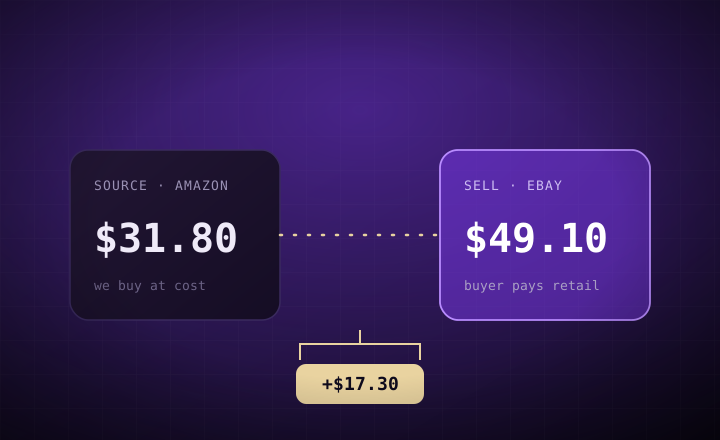
Sell on eBay, fulfil from Amazon, an experienced operator runs everything, and the store's owner collects a share of the profit for almost no time investment. That's not similar to the Dealixo model — it is the Dealixo model. The country's biggest business newspaper just documented, with real names and real numbers, that this arrangement exists and pays.
The WSJ's example client: about $6,000 a month, about one hour a week. The model: managed eBay stores fulfilled from Amazon — exactly what we run.
The losers in the article all made the same mistake
The piece is just as valuable for its failures. It tells the story of a woman who spent over $3,500 on passive-income courses — soap making, beekeeping, newsletters — and earned about $250 from a year of effort on her best idea. It cites the Better Business Bureau finding that the median loss on failed business-opportunity courses is over $1,300, and an FTC case that clawed back $2.8 million from an operation selling “passive income on autopilot” with fake reviews.
Notice the pattern: the people who lost money all paid upfront for a dream — a course, a system, a promise — and were then left alone to do the hard part themselves. The people who succeeded either built something real once, or had someone competent running the operation for them.
That distinction is the entire article in one sentence, and it's the test we'd tell you to apply to anything in this space, including us.
Nobody in the article got rich buying a course. The winners either built the machine — or knew the person who ran it.
“Passive” is the wrong word — “managed” is the right one
Here's the honest part the hype merchants skip, and the Journal doesn't: none of this income is truly passive. The lint-roller engineer spent years on design before it ran itself. The eBay stores in the article work because an operator watches prices, stock, and customer messages every single day.
Income only feels passive to the person who isn't doing the work. Someone is always doing the work. The real question is whether that someone is you at 11pm after your day job — or a team whose entire business is running stores well, and who only earns when your store earns.
That's why our arrangement is a profit split rather than a course fee. We don't get paid for selling you a dream upfront; we get paid a share of what your store actually nets, month by month, with every number on the report.
The warnings worth taking seriously
We'd be selling you the same hype the article criticizes if we skipped its cautions. Three of them matter:
- Crowding is real. Strategies that get famous get saturated. The answer is operating discipline — product research, pricing, and account health — not chasing whatever went viral this month.
- Upfront-fee sellers are the red flag. The FTC cases and course losses in the article all share one shape: pay first, dream later. Be suspicious of anyone in this industry whose money comes from the fee, not the store's results.
- This is retail, not a lottery ticket. Real stores have slow months, refunds, and fees. Anyone promising a fixed monthly figure is guessing at best.
So what should you take from the article?
Two things, honestly held at the same time. First: the model works, and it's now documented far beyond our own reports — managed eBay-from-Amazon stores are earning real owners real money for an hour a week of involvement. Second: the gap between the people it works for and the people it burns is the operator. Not the idea, not the course, not the hustle — the person or team actually running the store.
If you've been reading our reports each month, none of this is news; you can see your revenue, costs, fees, and split down to the order. If you're new here and the WSJ piece is what brought passive income onto your radar — this is what we do all day, and we're happy to show you a real store's numbers rather than a dream.
Key takeaways
- The WSJ named passive income the new American Dream — and profiled managed eBay-from-Amazon stores as a working example.
- The example client in the piece: ~$6,000/month for ~1 hour a week, with an operator running everything.
- Everyone in the article who lost money paid upfront for a course or a promise, then had to do the work alone.
- No income is truly passive — someone always does the work. The question is who.
- Judge any operator by whether they earn from your results (profit split) or from your hope (upfront fees).
This post discusses reporting from the Wall Street Journal's July 2026 feature on passive income. All profiled individuals and figures referenced are from that piece: “Forget Work. Passive Income Is the New American Dream.” — wsj.com
The store runs. You relax.
We do everything; you collect your share and 100% of the cashback.
Request info