
The fastest route to a dead store is listing whatever looks interesting and hoping. We don't guess. Every product we add to your store passes through a research process designed to answer a single question: will this reliably sell, at a real profit? Here's how that filtering actually works.
We start with demand, not hunches
The first filter is evidence of demand. We look at real sell-through data — how often an item actually sells versus how many are listed — alongside current demand and any seasonality.
A product that sells through quickly and consistently is a candidate. A slow mover, no matter how appealing it looks, isn't. We'd rather list fewer products that move than a catalogue that just sits there.
The margin has to survive the fees
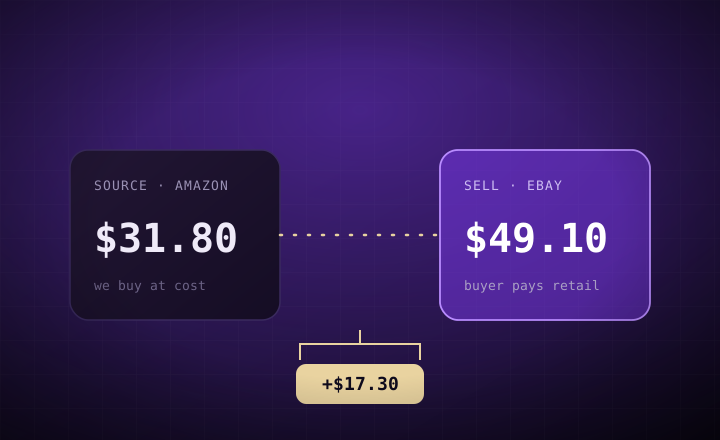
Demand alone isn't enough — the numbers have to work after everything is taken out. Every potential product is run against its Amazon source price, eBay's selling fees, and shipping.
If there isn't a healthy, repeatable margin left at the end of that, it doesn't make the cut, regardless of how popular it is. Because we only earn when you do, we're filtering hard for genuine profit, not vanity sales.
A product that sells constantly but leaves no margin after fees is a trap, not an opportunity. We pass on those.
We avoid the traps
Some products look great and quietly cause problems. We steer clear of the ones that do:
- Oversaturated items where dozens of sellers have raced the price to nearly zero.
- Restricted or gated categories that put your account at risk.
- Products that historically attract high return rates.
- Items prone to rights-owner or authenticity complaints.
The supplier has to be dependable
A great product with a flaky supplier is a liability. The final filter is fulfilment: each item has to be sourceable reliably from Amazon — in stock, stable pricing, and fast shipping.
If a product can't be delivered dependably, it doesn't matter how well it would sell; it puts your account and your buyers' trust on the line, so it's out.
We're not trying to list the most products. We're trying to list the right ones.
What you end up with
The result of all that filtering is a store stocked with products chosen to sell and to pay — not a random pile of listings. And because research never really stops, the catalogue keeps evolving as demand shifts, all without you lifting a finger.
Key takeaways
- Every product is chosen on evidence of demand, not a hunch.
- Margin is checked after Amazon cost, eBay fees, and shipping — or it's cut.
- We avoid saturated, restricted, return-heavy, and complaint-prone items.
- Suppliers must be reliable, or the product is dropped.
- You get a curated, evolving catalogue — not a random list.
Passive income, actually passive.
We handle listings, orders, pricing, and support. You do nothing.
Request info